All published articles of this journal are available on ScienceDirect.

Prolonged Severe Hyperglycemia Requiring High-Dose Insulin After COVID-19 in a Patient with Type 2 Diabetes and Recent Long-Term Marijuana Cessation: A Case Report

Abstract
Introduction
COVID-19 is an illness first identified in December 2019. It can cause numerous acute clinical symptoms, including fever, cough, fatigue, dyspnea, and the presence of sputum. Previous literature has shown that acute illness can cause a transient rise in blood glucose levels.
Case Presentation
A white male in his 40s was diagnosed with type 2 diabetes mellitus and presented with COVID-19 infection. Blood glucose levels were rising, with a daily average of 390 mg/dL. Initially, this rise in blood glucose appeared to be due to acute illness or stress. However, the patient’s blood glucose values continued to rise post-infection despite increased insulin therapy, suggesting a potential loss of pancreatic beta-cell function.
Conclusion
This patient case report suggests that COVID-19 infection may transiently impair beta-cell function in patients with type 2 diabetes, mimicking type 1 diabetes-like presentations.
1. INTRODUCTION
The coronavirus, also known as COVID-19, emerged in December 2019, and the World Health Organization classified it as a public health emergency. COVID-19 can cause numerous acute clinical symptoms, including fever in 81.2% of patients, cough in 58.5%, fatigue in 38.5%, dyspnea in 26.1%, and the presence of sputum in 25.8%, among other less common symptoms [1, 2]. While COVID-19 is typically mild in most patients, there is a risk of long-term effects of the infection, and patients with comorbidities are at the highest risk. For example, the coronavirus can cause respiratory failure, shock, liver failure, arrhythmias, cardiovascular damage, or kidney failure [3, 4].
Type 2 diabetes is a chronic disease affecting the pancreas [5]. Type 2 diabetes is characterized by insulin resistance and is identified if fasting blood glucose is ≥126mg/dL, A1c ≥6.5%, two-hour post-prandial blood glucose ≥200mg/dL after a 75g glucose tolerance test, or random blood glucose ≥200mg/dL. Diabetes can cause numerous micro- and macrovascular complications, including cardiovascular disease, retinopathy, chronic kidney disease, or stroke [6].
Previous literature has shown that acute illness, such as the coronavirus, and increased stress, potentially from cessation of marijuana use, can cause a transient rise in blood glucose levels [7]. One 2013 study showed that current use of marijuana was associated with 16% lower fasting insulin levels and 17% lower homeostasis model assessment of insulin resistance [8]. Studies completed in 2016 and 2017 showed THC and CBD decreased blood glucose, increased insulin production, and were linked with lower insulin resistance [9, 10]. However, literature is conflicting, as the American Diabetes Association has stated that there is no noticeable effect on blood glucose or insulin levels in patients with type 2 diabetes using marijuana [11]. One article suggested prior THC use may improve a patient's insulin sensitivity, as other articles have demonstrated there is no clear consensus or delineated outcomes for the true impact of prior THC use and insulin activity [8, 12]. Critical evaluation of THC and insulin requires substantially better controlled studies on patients long term insulin sensitivity to get a true idea of its impact.
A few studies have hypothesized that diabetes mellitus in the setting of COVID-19 infection could lead to inappropriate beta-cell function or apoptosis.[13, 14, 15] One possible mechanism for this includes activation of the Renin-Angiotensin-Aldosterone System (RAAS), which leads to the imbalance of angiotensin-2 (AT-2) and Angiotensin-Converting Enzyme-2 (ACE-2). While AT-2 is thought to be prooxidant, pro-constrictive, hypertropic, proinflammatory, proliferative, and profibrotic, ACE-2 is the opposite. It is speculated that RAAS activation occurs via COVID-19 binding to ACE-2 in pancreatic islet cells, diminishing their proliferative capacity and activating the systemic RAAS and the localized RAAS in the epithelial ductal cells of the exocrine pancreas [13]. When COVID-19 results in uncleaved AT2, islet cell damage and cell death may occur [14]. The presence of COVID-19 and its ability to harm them has been previous described [16]. In this study, the harm was demonstrated both in vivo and in vitro and led to beta cell death via apoptotic kinase activity.
A retrospective assessment was conducted of the incidence of diabetes during the COVID-19 pandemic. Izzo et al. compared the incidence before and after the pandemic in Italy and found that there was a significant increase in type 2 diabetes during the study period when using pre-pandemic rates as a control [17]. This finding was mirrored in Thailand, where a significant increase was also reported [18]. In a cohort study of a Korean population, there was also an increase in both type 1 and type 2 diabetes, yet the authors could not assert with certainty that COVID-19 was the causal factor, since the rates dropped after the pandemic ended [19]. When taken together, the biochemical and clinical data demonstrate that continued studies on the intersection between COVID and diabetes are crucial [20, 21].
2. CASE PRESENTATION
The patient in his 40’s had been diagnosed with type II diabetes mellitus in April 2021 when blood work revealed hemoglobin A1c 9.7% (Fig. 1). Additionally, a total insulin level was normal at 13.9 munit/L (reference range 4-28), and C-peptide was slightly elevated at 4.51 ng/mL (reference range 0.81-3.85), which confirmed the type 2 diabetes diagnosis. The patient had presented to the clinic with classic symptoms, including blurry vision, polydipsia, and polyuria. His additional medical history is significant for essential hypertension, mild intermittent asthma, and general anxiety disorder. His pertinent social history is significant for tobacco use and daily marijuana use. Patient reports using the same supplier for his marijuana for decades. He denied alcohol or other recreational drug use. His medications included lisinopril 20mg once daily, atorvastatin 40mg once daily, escitalopram 20mg once daily, and albuterol 90mcg/actuation 1 puff every 4 to 6 hours as needed. His medications for diabetes management will be discussed at further length below.
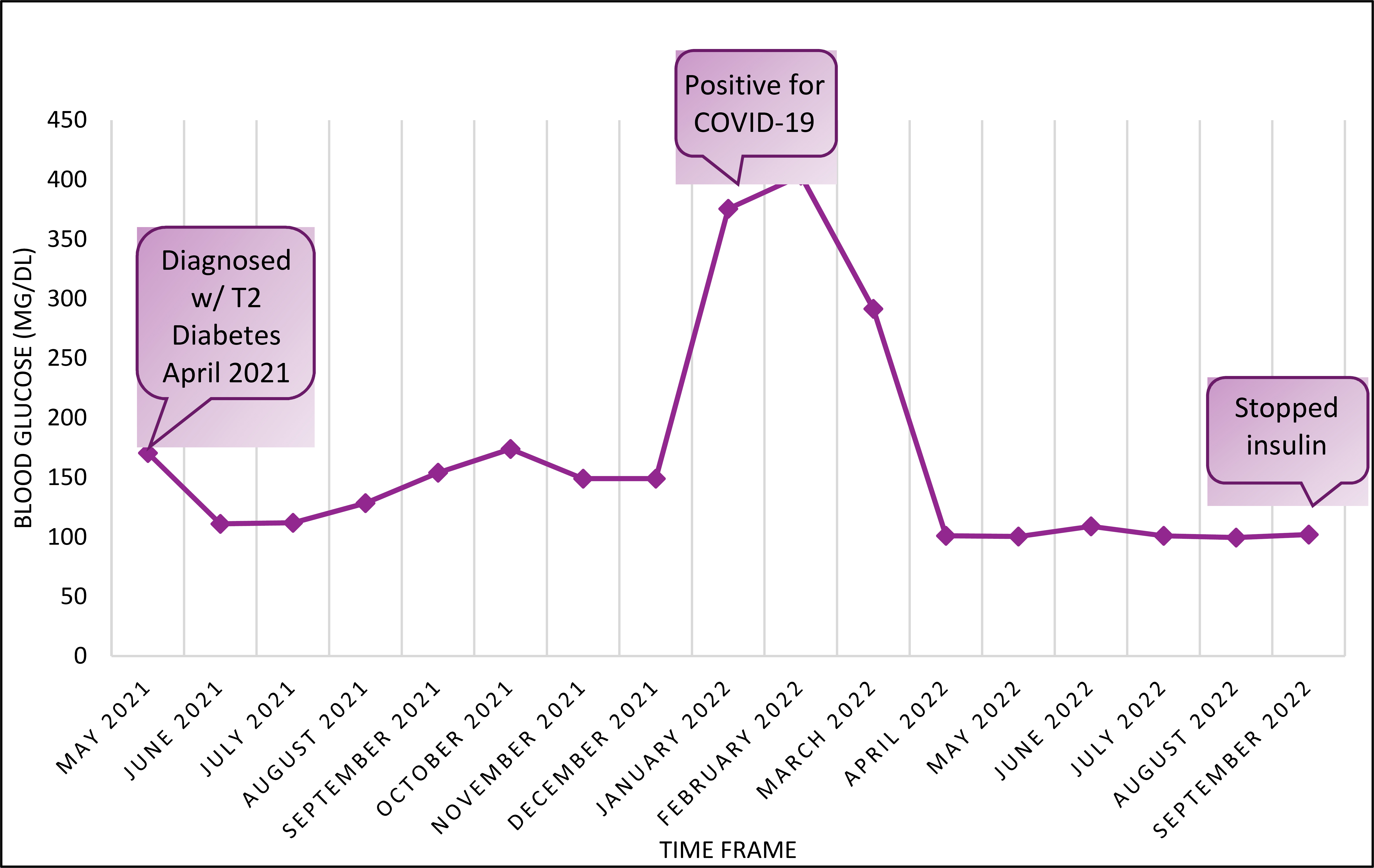
This figure shows the patient’s blood glucose time course from April 2021 through September 2022.
During his initial visit for newly diagnosed type 2 diabetes mellitus, he was initiated on metformin extended release 500mg once daily (with plans to titrate up), dulaglutide 0.75mg weekly, and insulin glargine 36units daily. Over the course of the next seven months, his medications were titrated accordingly for a goal hemoglobin A1c<7%; however, metformin and dulaglutide were stopped shortly after initiation due to side effects. Insulin adherence and injection technique were confirmed at each visit.
By November 2021, his hemoglobin A1c had improved to 8.3%, although he was still not in adequate control despite medication therapy and lifestyle modifications.
In January 2022, the patient’s blood glucose levels began to rise when the patient’s blood sugars rose to an average of 288mg/dL despite continued lifestyle modifications, which consist of a consistent diet and moderate intensity exercise three days per week and insulin glargine use at 34 units daily. The patient denied expired or improperly stored insulin; thus, his dose was increased to 40 units daily. Three days later, his blood glucose ranged from 287mg/dL to 497mg/dL. Injection adherence and technique were again assessed and appropriate. The primary care physician prescribed empagliflozin 10 mg; however, the patient never picked up the prescription from the pharmacy. Of note, the patient also reported cessation of a 25-year history of marijuana use since January 1, 2022, when he started a new job and underwent frequent urine drug screens. He has held this job for the duration of the case report and has not resumed marijuana use.
Only 6 days after reporting increased blood glucose levels, our patient tested positive for COVID-19 but did not require hospitalization; at that time, his blood glucose was averaging 390mg/dL. The office staff gave the patient some time to recover from the acute illness, hoping that glucose values would stabilize; however, values remained >300mg/dL, indicating an increase to 50 units of basal insulin daily. Unfortunately, a repeat C-peptide level and homeostatic model assessment of insulin resistance could not be obtained.
By February 2022, the patient’s hemoglobin A1c had worsened to 13.8%, requiring titration of basal insulin to 60 units and initiation of a glucagon-like peptide-1 (GLP-1) agonist, semaglutide 0.25mg weekly. At his next follow-up appointment, his glucose logs showed that his average blood glucose remained elevated at 405mg/dL, ranging from 266mg/dL to >500mg/dL, so he was further increased to semaglutide 0.5mg weekly, 80 units of basal insulin, and initiated on insulin lispro 12units two times daily. Given his high insulin requirement, the diabetes care team began the approval process to get the patient on concentrated insulin (insulin degludec). Additionally, the team attempted to rule out other confounding factors, including diet/exercise changes, adherence to medications, and injection technique. He was seen for follow-up in mid-March 2022, where semaglutide was increased to 1mg weekly, and Tresiba was continued at 80 units daily. The patient's weight remained stable despite being on Ozempic. During this appointment, the patient admitted he had not started bolus insulin coverage for unknown reasons. He was advised to start 12units with each meal.
During his follow-up in April 2022, the patient's blood glucose had stabilized while on 80 units of insulin degludec and 1mg of semaglutide. His average blood glucose was 113mg/dL, ranging from 62mg/dL to 386mg/dL. He again reported not having initiated the bolus insulin. His time in fasting target was 79%, and time in post-prandial target was 80%. His hemoglobin A1c was retested in May of 2022 and had significantly improved, near goal at 7.2%. At this time, the patient had lost approximately 4 pounds, which he correlated with his semaglutide use. He continued his moderate intensity exercise 3 days per week.
The patient tested positive for a second time in August 2022, although symptoms were mild and treated supportively at home. He did not require hospitalization or treatment with nirmatrelvir/ritonavir. His blood glucose at that time was 95% in the target range, averaging 106 mg/dL with a range of 77mg/dL to 130mg/dL. His hemoglobin A1c was 5.6%, and he was able to titrate down insulin degludec by 2 to 4 units daily. He was off insulin in September 2022 and has since been under glycemic control with GLP-1 therapy. He is currently treated with semaglutide 1mg weekly. He continued to stay active with moderate intensity exercise three times weekly.
3. DISCUSSION
As depicted in this case report, this patient displayed increasing insulin resistance after infection with COVID-19. His uncontrolled glucose levels lasted well beyond what is typically seen in an acute period of illness. Further, despite multiple medication trials and insulin titration, his diabetes remained uncontrolled.
In this patient, basal insulin dosing was increased by 20-25% at each appointment, yet average blood glucose levels did not steadily decrease. His dietary habits remained at baseline; there were no notable changes in his activity level as he continued to exercise 3 days per week. The patient's weight remained stable throughout the case study, with small fluctuations of 2-4 pounds but never more or less between appointments. His condition gradually improved, and after eight months of insulin requirement, he was able to completely discontinue his insulin regimen.
During this 8-month period, the only reported changes in the patient's life were a COVID-19 infection and discontinuation of habitual marijuana use. Finally, due to the costs associated with C-peptide level assays, the patient did not obtain repeat measures. This missing lab value makes it more difficult to pinpoint the causes of beta cell loss.
There have been several reports of “post-COVID syndrome” to classify the wide range of health consequences present four or more weeks after infection. Since the virus was announced in 2019, the effects are still under investigation, therefore highlighting the importance of our case report. However, given the very close timing, we cannot clearly separate the effects of SARS-CoV-2 from those of abrupt cannabis cessation.
CONCLUSION
This case report, which presents a patient with a history of type 2 diabetes mellitus who developed worsening glycemic control post COVID-19 infection, suggests COVID-19 may lead to a transient decline in pancreatic beta cell function in patients with type 2 diabetes mellitus. Based on the published literature for COVID-19, this report demonstrates an opportunity to further review and identify what role COVID-19 infection may have in the pathophysiology of patients with diabetes, as well as blood sugar fluctuations with marijuana use.
AUTHORS’ CONTRIBUTIONS
The authors confirm their contributions to the paper as follows: A.B. and J.L.: The case report was conceived; A.B. and P.W.: Data collection was performed; A.B., P.W., and J.L.: Analysis and interpretation of the results were carried out; P.W.: The draft manuscript was prepared; A.B. and B.H.: Editing was performed. All authors reviewed the results and approved the final version of the manuscript.
LIST OF ABBREVIATIONS
| COVID-19 | = Coronavirus disease 2019 |
| THC | = Tetrahydrocannabinol |
| CBD | = Cannabidiol |
| RAAS | = Renin-angiotensin-aldosterone system |
| ACE-2 | = angiotensin-converting enzyme-2 |
| ANG II | = Angiotensin II |
| GLP-1 | = Gglucagon-like peptide-1 |
ETHICS APPROVAL AND CONSENT TO PARTICIPATE
Case reports are considered exempt from our institutional review board at Fort Wayne Medical Education Program.
ACKNOWLEDGEMENTS
Declared none.